
Sierra Lodgepole PinePinus contorta murrayanaHeight: 30' average mature height Zones: 3-8 Find my zone Aspect: mostly sun to full sun Watering: needs little to no summer water once established, one or two deep watering cycles per summer Maximum Water: tolerates occasional winter flooding but needs drier soil in the summer Habit: single stem or trunk Foliage: evergreen Native To: AK, CA, CO, ID, MT, NV, OR, SD, UT, WA, WY
This plant can't be shipped to California, Hawaii, Montana
Size Availability
The Sierra Lodgepole Pine grows mostly throughout the Cascade Range in Oregon with populations throughout the mountains of California as far south as the Sierra Range. The Sierra Lodgepole develops a tall, straight trunk with a narrow branch habit and deep roots. Trees are extremely wind and snow tolerant and are hardy to -50 degrees, allowing them to survive at extremely high elevations in semi-alpine conditions. In the Cascade mountains around our nursery Lodgepole Pines are one of the predominant pine species and are often mixed with Mountain Hemlock at the upper limit of the tree line near the tops of the mountains. The only other pines that can consistently grow higher than them are the Whitebark Pine in Oregon and the Foxtail Pine in California.
quart - $12.50 each
Bulk Pricing: $10.00 each for 5 or more - 20% off Bulk Pricing: $8.50 each for 50 or more - 32% off Bulk Pricing: $6.50 each for 100 or more - 48% off
Ships free with orders of $75!*Packed with a bagged root ball.
In the landscape Sierra Lodgepoles are popular for their dark green color and dense branching habit, it is also one of the best pines for creating a tall privacy hedge. They are also very popular for bonsai with short needles and lots of stocky branches that develop a thick diameter quickly. Lodgepole Pines do best in well drained soil and don't like to be over-watered during the summer.
Adaptation to fire
Unlike most conifers, Lodgepole Pines don't drop their seeds every year but store them so they can be released after a fire. The scales on the cones remain sealed shut to hold the seeds in until the heat from a fire triggers the cones to open over the next few months. This adaptation allows many years' worth of seed to be stored and protected until after the forest is cleared in a fire so that millions of pine seeds can drop into an environment with almost no competition. The unprotected seeds of most other species will usually perish in the heat and so pure stands of Lodgepole Pines will quickly fill in after a fire. For this reason most Lodgepole Pines in a forest will be of an identical age and will all be roughly the same size. However, since almost no new trees will germinate until the next fire most of the Lodgepoles are slowly replaced by other conifers.
The many subspecies of the Lodgepole Pine The Lodgepole Pine has several distinct subspecies from its different primary ranges. The Sierra Lodgepole, Pinus contorta sub. murrayana, is native from the southern end of Washington in the Cascade Volcano Range through Oregon and to the Sierra Range in California. There is also a small, shrubby form native to the coast along the Pacific Ocean with the form P. contorta sub. contorta growing in Oregon and Washington and P. contorta sub. bolanderi growing along the coast in northern California. The most wide-spread subspecies is the Rocky Mountain Lodgepole P. contorta sub. latifolia which grows from Canada to Colorado.  Large Sierra Lodgepoles on a granite ridge
Source: Commons.
 High elevation Sierra Lodgepoles
Source: Commons.
 Open forests of Lodgepole pines
Source: Commons.
 Trees growing along a mountain creek
Source: Commons.
 Lone trees growing at extreme alpine elevations
Source: Commons.
 A young tree growing in a lower elevation forest
Source: Commons.
 Close up of a seed cone - these only drop their seeds after a fire
Source: Commons.
 A forest of lodgepole seedlings quickly re-forming a forest after a fire
Source: Commons.
Packing Plants For ShippingWe pack our plants depending on the needs of each species and size, most plants ship best with the roots packed in moist sawdust or bark fines but some species don't like root disturbance and are shipped in a soil-less growing media.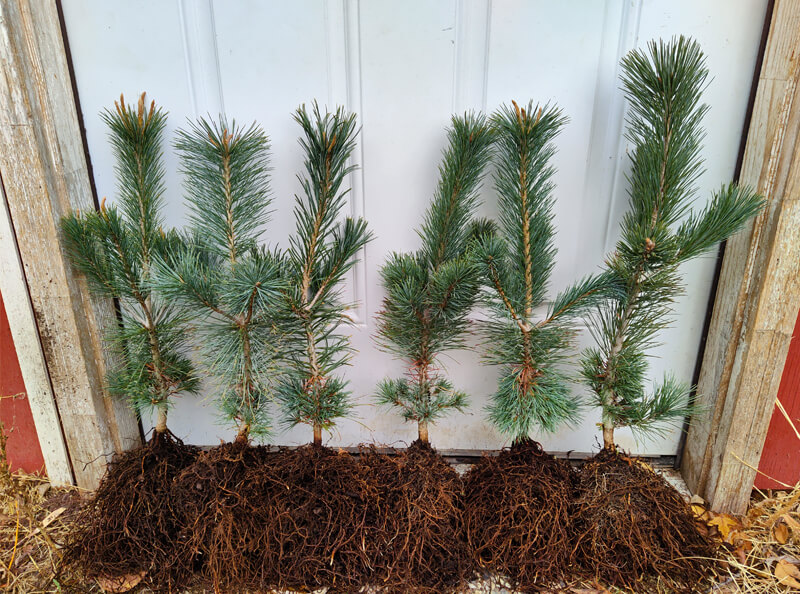 Excess soil is washed from the roots in preparation for shipping (18-24" White Pines) 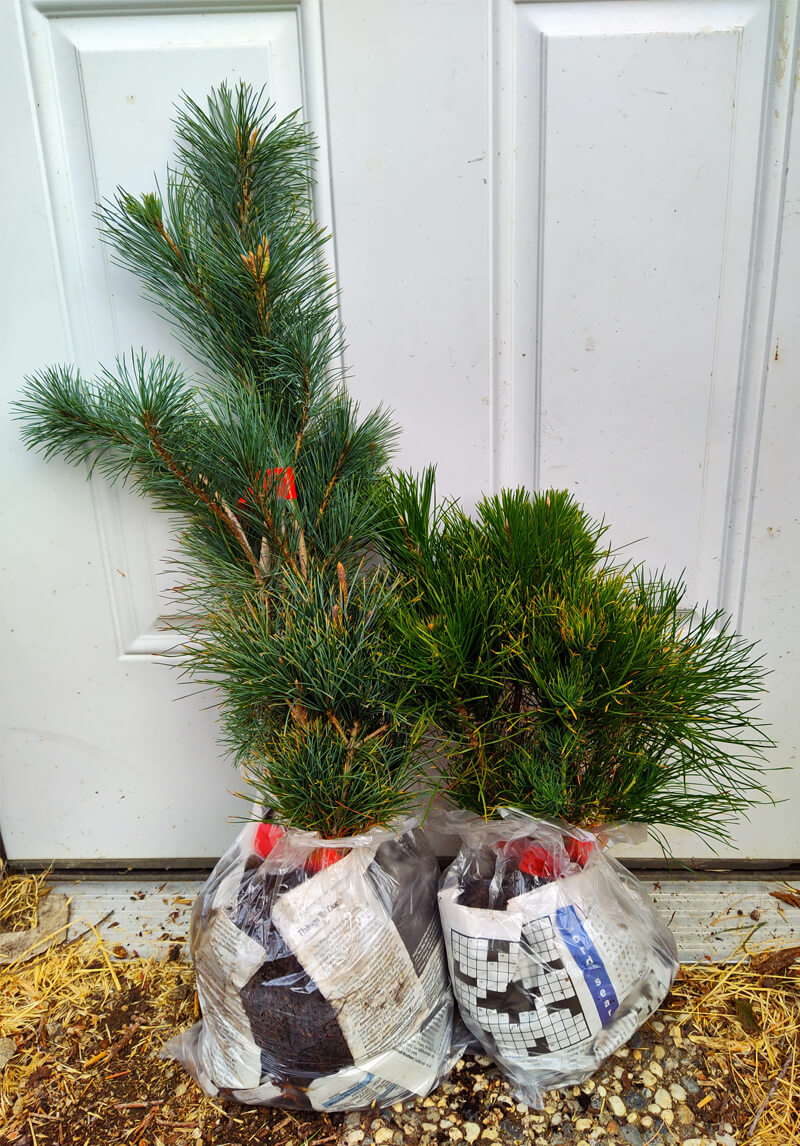 Plants are bundled together to fit in boxes  Bundles of plants are secured in long boxes. Plant Sizes 3 gallon Dawn Redwood 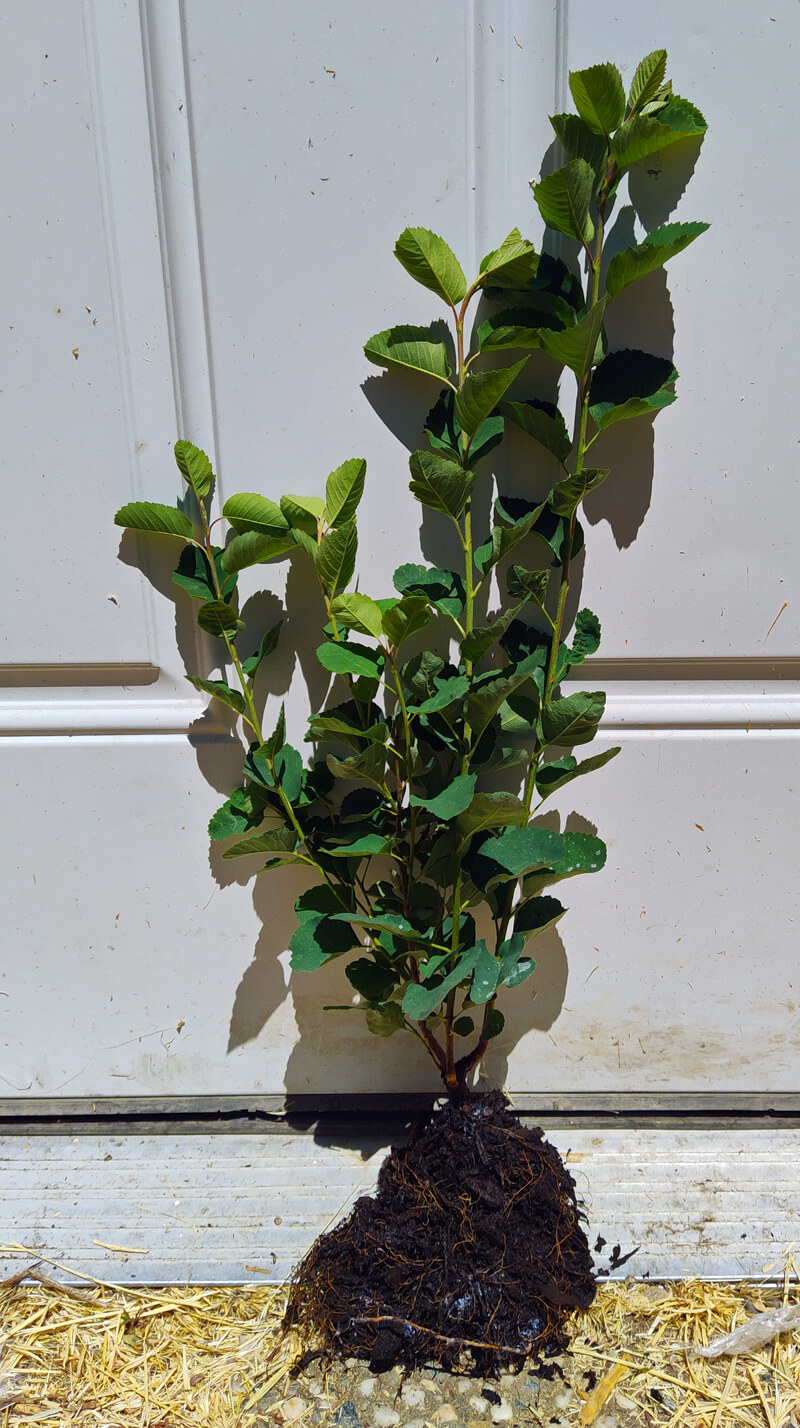 Standard quart shrub  Standard 14-18" multi-stem tree size  Standard deep plug pine tree Bamboo Plants Are Shipped In Their ContainersBamboo roots are not flexible and so plants have to be shipped in their containers. These plants are heavier and are shipped separately from bare root plants. Because they are potted they can handle longer transit times so can ship via UPS Ground instead of USPS Air Mail. Potted plants can also be shipped year-round.We regularly top our 1 gallon bamboo plants at 24-30 inches tall throughout the growing season. This results in dense, bushy foliage while allowing for economical shipping. From this size most running species will grow to 5-6 feet tall in the first spring and clumping species will usually grow to 4-5 feet tall.  1 gallon bamboo plants strapped in and ready to be sealed. Unpacking Bare Root PlantsYou will be sent tracking details as soon as your plants are shipped. Unpack your plants as quickly as possible after they are delivered. We use two types of boxes, side-sealing and top-sealing. For boxes that are taped along the whole length you can cut the tape on either side and remove the plant bundles by cutting the tape holding the bundle to the bottom. For boxes that are sealed on the top and bottom, it is easiet to open the bottom of the box (the shipping label is at the top) and pull the bundle of plants out straight out. Check that the box is empty as there can be a second bundle of plants stuck towards the top. A bundle of trees. What if I am not able to plant right away?You can usually leave the plants in their shipping container unopened for 1-2 days if there were no shipping delays and you have received your plants from late November through February. Plants shipped when it is warmer can't stay in their packages for as long.For longer term storage of plants you can pot them up or plant them in rows close together temporarily and then pull them out later in the spring to be planted again. This keeps the roots moist while allowing for air flow to the tops. The roots should have good contact with the soil to ensure they have access to adequate moisture. |
Size Availability
quart - $12.50 each
Bulk Pricing: $10.00 each for 5 or more - 20% off Bulk Pricing: $8.50 each for 50 or more - 32% off Bulk Pricing: $6.50 each for 100 or more - 48% off
Ships free with orders of $75!*Packed with a bagged root ball.
|
 Red Panda Nursery