
Variegated Japanese MapleAcer palmatum 'Oridono Nishiki'Height: 10' average mature height Zones: 5-8 Find my zone Habit: single stem or trunk Foliage: deciduous
Size Availability
Sold out.
Our main crop of most plants is available starting in late fall.
Additional batches of plugs and quarts are added throughout the year.
Many of our plants are propagated in limited quantities and can sell out quickly when posted, get on the notification list below so you don't miss out. Add your email to be notified as soon as we have them back in stock:
This does NOT subscribe your email to any mailing lists, our system will only send an inventory notification message.
Production notes: currently not in production; often we have replaced this variety with a better alternative but it is still in our catalog as we may produce limited batches in the future
Oridono Nishiki is one of the fastest growing varieties of Japanese Maples that are variegated, producing growth of 2-3' per year under good growing conditions. The leaves are attractively variegated with random spots and stripes of either cream or pink, with especially strong pinks in the spring. About 10-20% of the leaves will go beyond the typical spotting and striping and instead feature leaves evenly divided between a green half and a full cream or pink half. As the season progresses more leaves will be produced that are green which is what allows the tree to grow at a more reasonable rate than many other variegated varieties (the variegated portion of the leaf is not able to photosynthesize as effectively as green leaves).
Like most other variegated Japanese Maples, the variegation is often better on established trees with young trees typically displaying less variegation for the first year or two.
Care and Receiving Your Tree
Like with other plants that are shipped bare root, you should plant your tree as soon as possible. When planting be sure to spread the roots out a little so they are not clumped together at the bottom of the hole. Japanese Maples want the top of their root crown to be covered with just an inch of soil - be careful not to apply heavy mulch directly on top of the roots as this can suffocate them. Water heavily as soon as you plant your tree but after that be careful not to overwater this beautiful specimen - Japanese Maples prefer long but less frequent watering. During the growing season we water our established trees for two hours once per week, depending on the climate and how hot/dry the weather is (maybe a little more frequently during the hottest part of the year and less frequently during spring and fall when it is cooler). If you are growing your Japanese Maples in containers be sure to use a well-drained soil mix (not peat or compost based, bark based soils do best) and water whenever the soil starts to dry out.
Japanese Maples do best when fertilized in the spring, we recommend a slow release pellet like Osmocote Plus in April. Don't apply fertilizer later than mid-June because it will encourage too much late season growth that will not have time to harden off enough for winter. The exact formula doesn't matter too much, we usually use 15-10-10 but any other works fine for Japanese Maples. Osmocote is the brand we use because it releases steadily for several months and so there is very little risk of over-fertilizing your plants.
 White and pink leaves that typically appear on very shaded portions of trees  White and pink leaves that typically appear on very shaded portions of trees  Close up of the variegation around the edge of a leaf
Source: Commons
 Close up of the variegation around the edge of a leaf
Source: Commons
 A variegated Oridono Nishiki tree
Source: Commons
 Sample size of a one gallon tree, they are pruned back to around 16-18 inches tall Packing Plants For ShippingWe pack our plants depending on the needs of each species and size, most plants ship best with the roots packed in moist sawdust or bark fines but some species don't like root disturbance and are shipped in a soil-less growing media.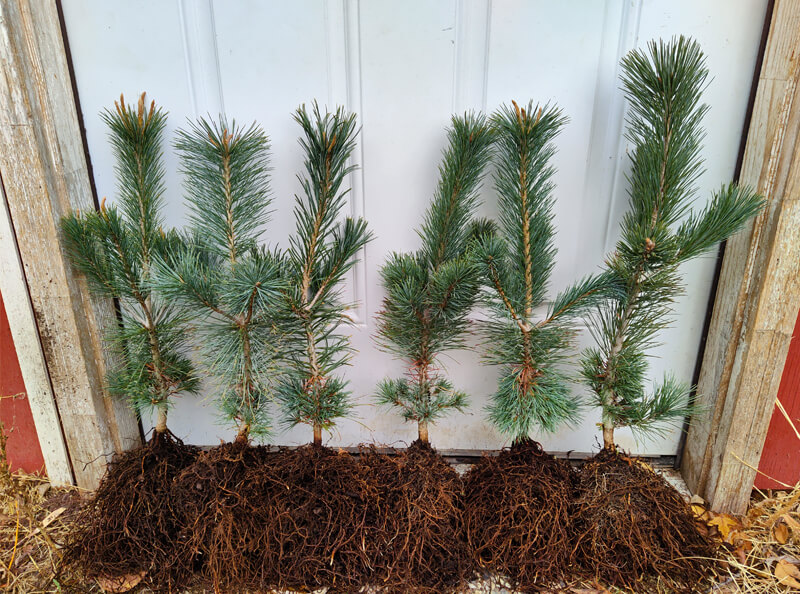 Excess soil is washed from the roots in preparation for shipping (18-24" White Pines) 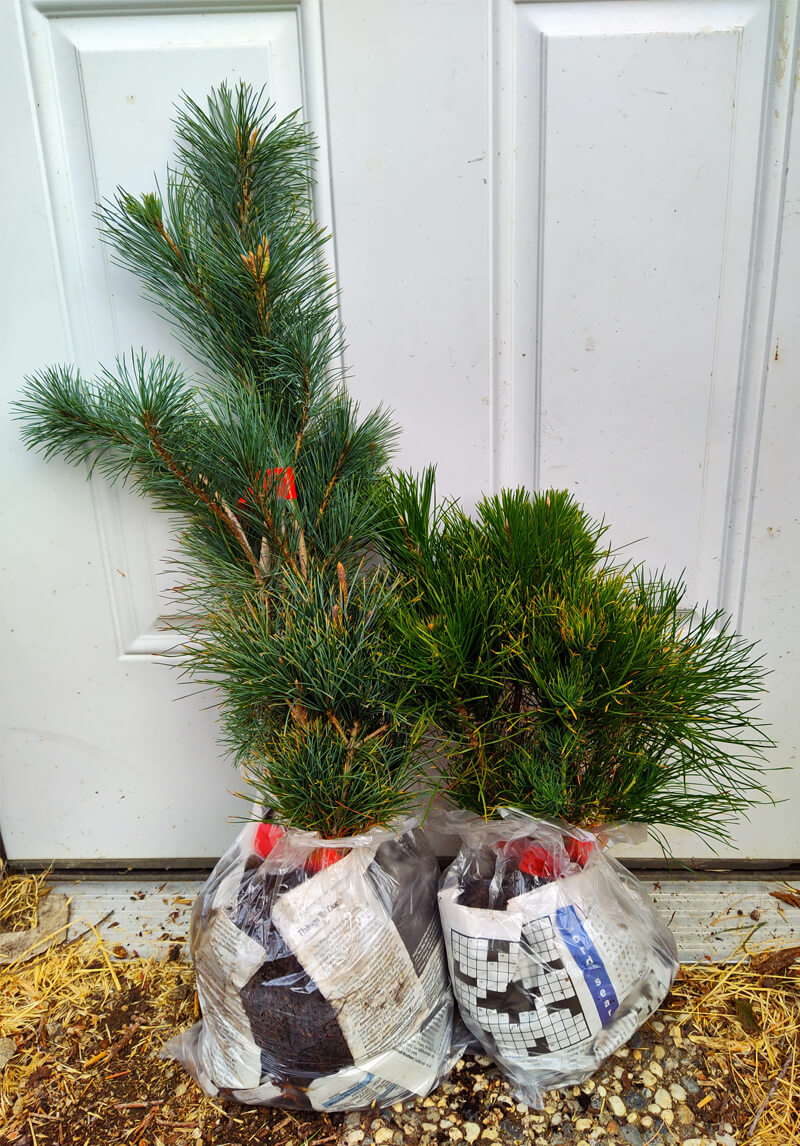 Plants are bundled together to fit in boxes  Bundles of plants are secured in long boxes. Plant Sizes 3 gallon Dawn Redwood 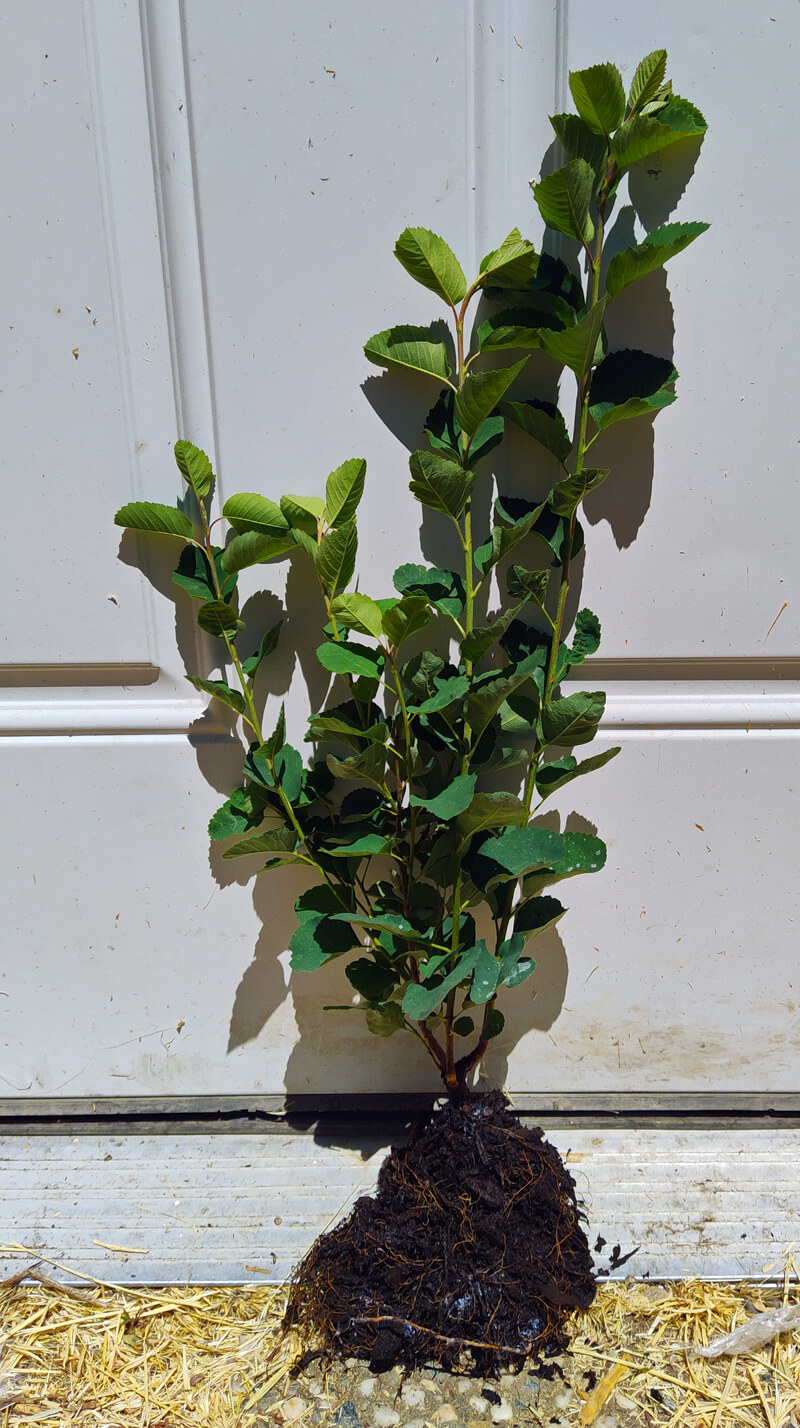 Standard quart shrub  Standard 14-18" multi-stem tree size  Standard deep plug pine tree Bamboo Plants Are Shipped In Their ContainersBamboo roots are not flexible and so plants have to be shipped in their containers. These plants are heavier and are shipped separately from bare root plants. Because they are potted they can handle longer transit times so can ship via UPS Ground instead of USPS Air Mail. Potted plants can also be shipped year-round.We regularly top our 1 gallon bamboo plants at 24-30 inches tall throughout the growing season. This results in dense, bushy foliage while allowing for economical shipping. From this size most running species will grow to 5-6 feet tall in the first spring and clumping species will usually grow to 4-5 feet tall.  1 gallon bamboo plants strapped in and ready to be sealed. Unpacking Bare Root PlantsYou will be sent tracking details as soon as your plants are shipped. Unpack your plants as quickly as possible after they are delivered. We use two types of boxes, side-sealing and top-sealing. For boxes that are taped along the whole length you can cut the tape on either side and remove the plant bundles by cutting the tape holding the bundle to the bottom. For boxes that are sealed on the top and bottom, it is easiet to open the bottom of the box (the shipping label is at the top) and pull the bundle of plants out straight out. Check that the box is empty as there can be a second bundle of plants stuck towards the top. A bundle of trees. What if I am not able to plant right away?You can usually leave the plants in their shipping container unopened for 1-2 days if there were no shipping delays and you have received your plants from late November through February. Plants shipped when it is warmer can't stay in their packages for as long.For longer term storage of plants you can pot them up or plant them in rows close together temporarily and then pull them out later in the spring to be planted again. This keeps the roots moist while allowing for air flow to the tops. The roots should have good contact with the soil to ensure they have access to adequate moisture. |
Size Availability
Sold out.
Our main crop of most plants is available starting in late fall.
Additional batches of plugs and quarts are added throughout the year.
Many of our plants are propagated in limited quantities and can sell out quickly when posted, get on the notification list below so you don't miss out. Add your email to be notified as soon as we have them back in stock:
This does NOT subscribe your email to any mailing lists, our system will only send an inventory notification message.
Production notes: currently not in production; often we have replaced this variety with a better alternative but it is still in our catalog as we may produce limited batches in the future
|
 Red Panda Nursery